
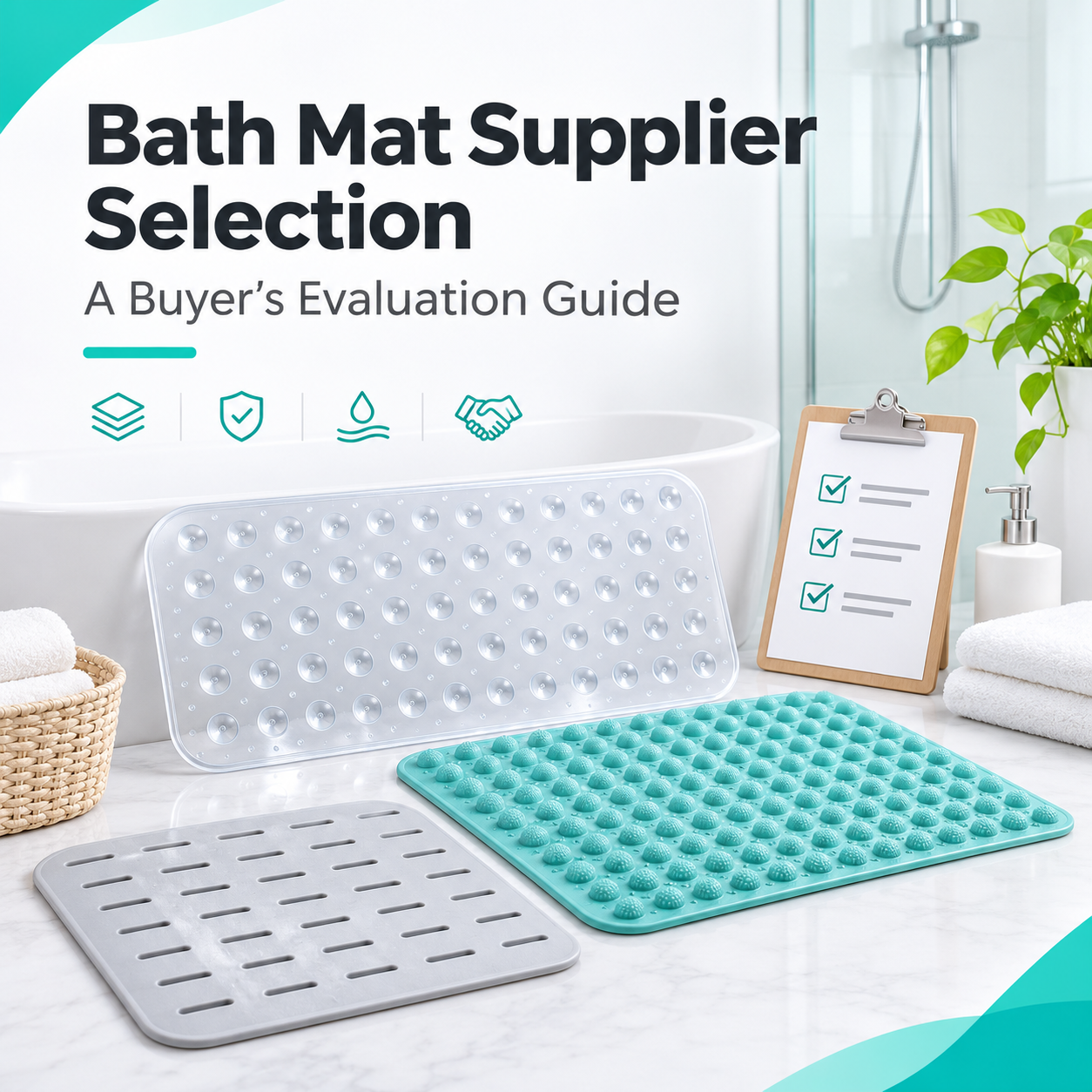
<h2>What a bath mat supplier actually needs to prove</h2><p>Most bath mat sourcing problems surface after the container ships: a mat that slides on a wet tile floor, a massage texture that flattens within weeks, a color that shifts between production runs, or a certificate that does not match the material actually used. Choosing a supplier is therefore less about finding the widest catalog and more about verifying four things: material consistency, anti-slip construction, texture durability, and documentation that survives a buyer's own compliance review.</p><p>This guide is written for buyers moving from consideration into supplier evaluation. It covers the decisions that matter across bath mats, shower mats, massage bath mats, and sink mats, and it flags where you should ask for evidence rather than accept a listing description.</p><h2>Start with the mat type, not the supplier</h2><p>Bath mat is an umbrella term, and suppliers often quote a single price band across items that behave very differently in use. Define the product family before you compare factories, because the construction requirements diverge quickly.</p><ul><li><p><strong>Bath mats</strong> sit beside or in front of the tub, so surface drying speed and edge finish matter more than suction grip.</p></li><li><p><strong>Shower mats</strong> sit inside a wet zone and typically rely on suction cups or a high-friction backing. Grip on a wet, possibly soapy floor is the primary failure point.</p></li><li><p><strong>Massage bath mats</strong> add a raised cell or nodule texture. The sourcing question is whether that texture is molded into the body or added as a separate layer, because that determines how it wears.</p></li><li><p><strong>Sink mats</strong> are smaller, often used to protect the basin or drain area, and are judged on fit, drainage, and resistance to standing water.</p></li></ul><p>If you are sourcing a mixed program, decide early whether one supplier should cover all four families or whether specialist factories per family give better control. A single supplier reduces administrative load; specialists often give tighter process control within a narrow product type.</p><h2>Material decision: TPE versus PVC</h2><p>The two materials most often quoted for anti-slip and massage mats are TPE (thermoplastic elastomer) and PVC. Both can be produced with an anti-slip surface and a textured massage face. The choice is a trade-off, not a ranking.</p><table style="min-width: 75px;"><colgroup><col style="min-width: 25px;"><col style="min-width: 25px;"><col style="min-width: 25px;"></colgroup><tbody><tr><th colspan="1" rowspan="1"><p>Consideration</p></th><th colspan="1" rowspan="1"><p>TPE</p></th><th colspan="1" rowspan="1"><p>PVC</p></th></tr><tr><td colspan="1" rowspan="1"><p>Typical buyer motivation</p></td><td colspan="1" rowspan="1"><p>Rubber-like feel, often positioned as an eco-friendly alternative</p></td><td colspan="1" rowspan="1"><p>Widely available, broad supplier base, familiar to most factories</p></td></tr><tr><td colspan="1" rowspan="1"><p>What to verify</p></td><td colspan="1" rowspan="1"><p>Actual polymer composition and whether recycled content is claimed</p></td><td colspan="1" rowspan="1"><p>Plasticizer type and content, since this drives odor and flexibility</p></td></tr><tr><td colspan="1" rowspan="1"><p>Odor risk</p></td><td colspan="1" rowspan="1"><p>Generally lower, but confirm with a sample</p></td><td colspan="1" rowspan="1"><p>Higher risk; always smell an unopened sample</p></td></tr><tr><td colspan="1" rowspan="1"><p>Texture retention</p></td><td colspan="1" rowspan="1"><p>Ask for compression or repeated-load test data on the massage cells</p></td><td colspan="1" rowspan="1"><p>Ask the same; soft compounds can flatten faster</p></td></tr><tr><td colspan="1" rowspan="1"><p>Documentation to request</p></td><td colspan="1" rowspan="1"><p>Material declaration and any test reports cited in the listing</p></td><td colspan="1" rowspan="1"><p>Material declaration plus plasticizer and heavy-metal statements</p></td></tr></tbody></table><p>Treat "eco-friendly" as a marketing term until it is defined. Ask the supplier to state which specific claim they are making, against which standard, tested by which laboratory, and on which date. A supplier who cannot name the standard is telling you something useful.</p><p>JIAJIELI's public catalog includes both TPE and PVC massage bath mats, including models JJ-1601256319533 (TPE) and JJ-1601245717375 and JJ-1601232500736 (PVC). Listings for these items reference certification, including a TUV reference on model JJ-1601232500736. The catalog itself notes that specifications should be confirmed at inquiry, so treat certificate scope, model coverage, and issue date as items to verify rather than assume.</p><h2>Anti-slip construction: the specification that decides returns</h2><p>Anti-slip is the most common cause of end-customer complaints and the hardest attribute to judge from a photo. Ask how grip is achieved, then test it under realistic conditions.</p><h3>Suction cup backing</h3><p>Best suited to smooth, non-textured surfaces such as glazed tile or acrylic tub floors. Cup count, cup diameter, and compound softness all affect hold. On textured or matte tiles, cups can fail to seal, so confirm the intended substrate with the supplier before committing.</p><h3>High-friction flat backing</h3><p>Works across more surface types but relies on the compound's coefficient of friction. This is where a lab-tested slip-resistance figure is worth requesting, along with the test method and the surface it was measured on.</p><h3>Drainage and edge design</h3><p>Holes, channels, and beveled edges affect both water clearance and trip risk. Ask for the drainage pattern to be shown on the actual production sample, not a rendering.</p><p>Whatever the design, run a wet test yourself: place the mat on the tile or tub surface you actually sell into, wet it with soapy water, and apply lateral force by foot. Repeat after the mat has been in use for a period. A mat that grips when new but creeps after a month is a formulation problem, not a design problem.</p><h2>Massage texture: how to judge durability before you order</h2><p>Massage cells are the feature buyers pay a premium for, and the first thing to degrade. Three questions cut through most of the risk:</p><ol><li><p><strong>Is the texture molded or laminated?</strong> Molded cells are part of the mat body and generally resist delamination. Added layers can separate at the bond line.</p></li><li><p><strong>What is the cell height and spacing?</strong> Taller, denser cells give stronger sensation but compress more under load. Ask for the specification in millimeters and confirm it on the sample.</p></li><li><p><strong>What evidence exists on compression set?</strong> Request any repeated-load or compression test data the supplier holds. If none exists, plan your own wear trial before scaling.</p></li></ol><p>Also check cleanability. Deep texture traps soap residue and hair, which drives negative reviews in hospitality and residential channels alike. Confirm the cell geometry can be brushed clean and that the material tolerates the cleaning chemicals your market uses.</p><h2>Certification and compliance: what to request and how to read it</h2><p>Certification claims are where catalog listings and procurement reality most often diverge. A certificate reference in a product title is a starting point, not proof.</p><ul><li><p>Ask for the certificate as a full document, not a cropped image, and check the certificate holder's legal name matches the entity you are contracting with.</p></li><li><p>Confirm the certified product scope covers the specific model and material you are buying.</p></li><li><p>Check the issue and expiry dates, and the issuing body.</p></li><li><p>Ask which test standard and which laboratory produced any performance data.</p></li><li><p>For destination-market requirements, confirm with your own compliance team which regulations apply to your product and channel; supplier statements are inputs, not determinations.</p></li></ul><p>Record every document you receive against the model number. When a factory runs several materials on similar tooling, model-level traceability is what protects you in a dispute.</p><h2>Supplier evaluation: questions that reveal capability</h2><p>Use the same question set across every candidate so answers are comparable. Vague answers are data too.</p><ul><li><p>Which production steps happen in-house, and which are subcontracted? Tooling, molding, and trimming are the steps to ask about specifically.</p></li><li><p>Can you send the material declaration and any test reports for the exact model quoted?</p></li><li><p>What is your process for color matching, and how do you control batch-to-batch variation?</p></li><li><p>How do you handle a failed incoming inspection or a non-conforming batch?</p></li><li><p>Can you produce the same model in more than one material, and what changes in the specification?</p></li><li><p>Who is my technical contact if a quality issue arises after shipment?</p></li></ul><p>Where a supplier cannot answer, ask them to confirm in writing that the point is not covered rather than leaving it ambiguous. Written gaps are easier to manage than verbal assurances.</p><h2>Sample and pre-production validation</h2><p>A sample is only useful if it is produced the same way as the bulk order. State that requirement explicitly when requesting samples, and ask whether the sample comes from the same tooling and material lot as production.</p><p>Build a short validation checklist and score each sample against it:</p><ul><li><p>Wet grip on your target surface, tested before and after a period of use</p></li><li><p>Odor from an unopened pack</p></li><li><p>Massage cell height, spacing, and recovery after compression</p></li><li><p>Color match against your approved reference under daylight</p></li><li><p>Edge finish, flash, and any sharp points</p></li><li><p>Drainage behavior and drying time</p></li><li><p>Dimensional tolerance against the stated specification</p></li></ul><p>Keep the approved sample sealed and signed as your golden reference. It is the only reliable benchmark if a later shipment is disputed.</p><h2>Warning signs in a supplier conversation</h2><p>Most of these appear early if you ask directly.</p><ul><li><p>Certificates offered only as low-resolution images, or with a holder name that differs from the contracting entity.</p></li><li><p>Specifications described only in marketing language, with no dimensions, material grade, or test method.</p></li><li><p>Reluctance to state which processes are in-house.</p></li><li><p>Samples that visibly differ from the catalog photo, with no explanation.</p></li><li><p>Pressure to commit to volume before a sample is approved.</p></li><li><p>No named technical contact after the quotation stage.</p></li></ul><h2>A practical next step</h2><p>Shortlist two or three suppliers, send the same written specification to each, and request samples produced on production tooling along with model-level documentation. Score the responses against the checklist above rather than against price alone, because the cost of a failed anti-slip or texture batch usually exceeds the gap between quotes. Where a listing references certification, make the full document a condition of the order, and confirm the certified scope covers the model and material you are buying.</p>