
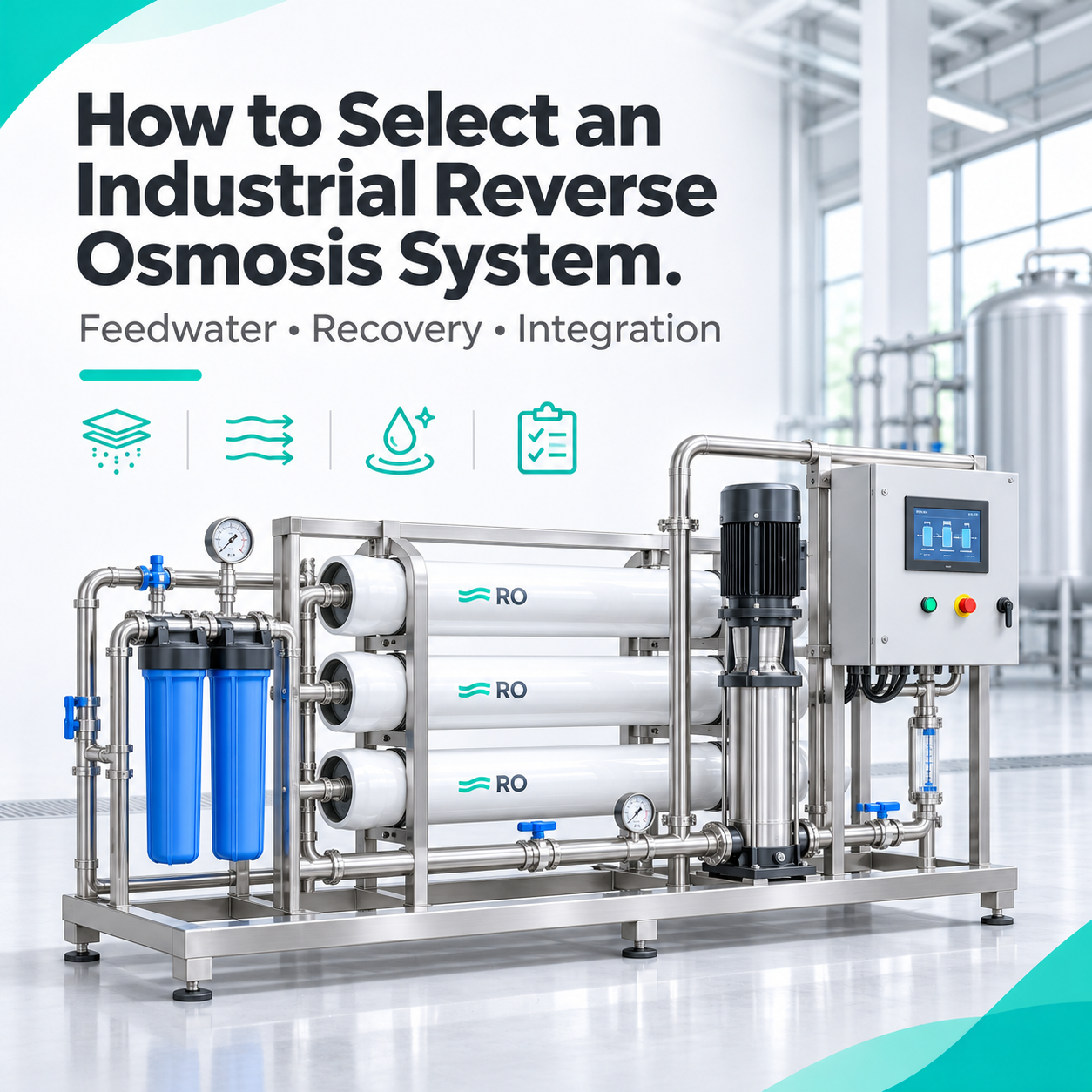
<p><span style="color: rgb(17, 24, 39); font-size: 10.5pt;"><em>A process-based guide to feedwater analysis, permeate demand, recovery, and system integration</em></span></p><p><span style="color: rgb(17, 24, 39); font-size: 10pt;">Select an industrial reverse osmosis system from feedwater analysis and required product-water quality, not a capacity label alone. Feed composition shapes pretreatment and membrane design; operating hours determine permeate flow; concentrate handling affects cost and permitting. JIE NENG lists single- and two-stage RO skids configured around feedwater and target quality. Its page describes skid materials, membrane housings, pumps, prefilters, pressure gauges, and conductivity monitoring, but publishes no standard flow range. Request a project-specific design basis.</span></p><h1><span style="color: rgb(17, 24, 39); font-size: 14pt;"><strong>Start with the Feedwater and the Point of Use</strong></span></h1><p><span style="color: rgb(17, 24, 39); font-size: 10pt;">A raw-water analysis should represent normal and challenging source conditions. For wells, surface intakes, municipal supply, or process-water reuse, gather conductivity or total dissolved solids, pH, temperature, hardness, alkalinity, silica, sulfate, chloride, iron, manganese, turbidity, suspended solids, and relevant organic or microbiological data. Seasonal changes matter: a membrane train sized from one clean sample may foul or scale when the source changes. Include existing pretreatment chemicals and upstream filters.</span></p><p><span style="color: rgb(17, 24, 39); font-size: 10pt;">Then define what “treated water” means at the point of use. Boiler makeup, electronics rinse water, food processing, and general manufacturing may have different limits for conductivity, hardness, silica, organics, or microbial control. RO reduces many dissolved constituents, but it does not by itself set a universal water-quality grade. If final resistivity or ionic purity is critical, the RO product page identifies EDI or mixed-bed polishing as a downstream step. State the required value, sampling method, and operating temperature in the purchase specification.</span></p><h1><span style="color: rgb(17, 24, 39); font-size: 14pt;"><strong>Size for Net Permeate Demand</strong></span></h1><p><span style="color: rgb(17, 24, 39); font-size: 10pt;">Calculate the daily permeate requirement from actual use points, not the largest connected pipe. Separate continuous demand from short peak draws and account for cleaning, product changeovers, planned maintenance, and storage-tank refill time. If the RO will operate for fewer than 24 hours per day, its operating-hour flow must be higher than the daily average. Make clear whether the quoted rating means feed flow, permeate flow, or nameplate membrane flow; those figures are not interchangeable.</span></p><table style="min-width: 75px;"><colgroup><col style="min-width: 25px;"><col style="min-width: 25px;"><col style="min-width: 25px;"></colgroup><tbody><tr><td colspan="1" rowspan="1"><p><span style="color: rgb(17, 24, 39); font-size: 7.5pt;"><strong>Sizing example (illustrative arithmetic, not a JIE NENG rating)</strong></span></p></td><td colspan="1" rowspan="1"><p><span style="color: rgb(17, 24, 39); font-size: 7.5pt;"><strong>Value</strong></span></p></td><td colspan="1" rowspan="1"><p><span style="color: rgb(17, 24, 39); font-size: 7.5pt;"><strong>Meaning</strong></span></p></td></tr><tr><td colspan="1" rowspan="1"><p><span style="color: rgb(17, 24, 39); font-size: 7.5pt;">Required permeate per day</span></p></td><td colspan="1" rowspan="1"><p><span style="color: rgb(17, 24, 39); font-size: 7.5pt;">100 m³/day</span></p></td><td colspan="1" rowspan="1"><p><span style="color: rgb(17, 24, 39); font-size: 7.5pt;">User-selected production target</span></p></td></tr><tr><td colspan="1" rowspan="1"><p><span style="color: rgb(17, 24, 39); font-size: 7.5pt;">Operating hours per day</span></p></td><td colspan="1" rowspan="1"><p><span style="color: rgb(17, 24, 39); font-size: 7.5pt;">20 h/day</span></p></td><td colspan="1" rowspan="1"><p><span style="color: rgb(17, 24, 39); font-size: 7.5pt;">Assumed operating schedule</span></p></td></tr><tr><td colspan="1" rowspan="1"><p><span style="color: rgb(17, 24, 39); font-size: 7.5pt;">Average permeate during operation</span></p></td><td colspan="1" rowspan="1"><p><span style="color: rgb(17, 24, 39); font-size: 7.5pt;">5.0 m³/h</span></p></td><td colspan="1" rowspan="1"><p><span style="color: rgb(17, 24, 39); font-size: 7.5pt;">100 ÷ 20; before peak or reserve allowance</span></p></td></tr><tr><td colspan="1" rowspan="1"><p><span style="color: rgb(17, 24, 39); font-size: 7.5pt;">Feed at 70% recovery</span></p></td><td colspan="1" rowspan="1"><p><span style="color: rgb(17, 24, 39); font-size: 7.5pt;">142.9 m³/day</span></p></td><td colspan="1" rowspan="1"><p><span style="color: rgb(17, 24, 39); font-size: 7.5pt;">Illustrative mass balance: feed = permeate ÷ 0.70</span></p></td></tr><tr><td colspan="1" rowspan="1"><p><span style="color: rgb(17, 24, 39); font-size: 7.5pt;">Concentrate at 70% recovery</span></p></td><td colspan="1" rowspan="1"><p><span style="color: rgb(17, 24, 39); font-size: 7.5pt;">42.9 m³/day</span></p></td><td colspan="1" rowspan="1"><p><span style="color: rgb(17, 24, 39); font-size: 7.5pt;">Feed minus permeate; disposal/reuse route must be checked</span></p></td></tr></tbody></table><p><span style="color: rgb(17, 24, 39); font-size: 10pt;"> </span></p><p><span style="color: rgb(17, 24, 39); font-size: 10pt;">The 70% recovery in this example is an assumption to show the calculation, not a recommended setpoint. EPA notes that RO/NF systems reject part of their feed as concentrate and that pretreatment is frequently needed to limit fouling or plugging. Actual recovery depends on feed chemistry, scaling limits, temperature, membrane selection, staging, and concentrate disposal. The engineer should model saturation and confirm the allowable operating envelope. A higher recovery may reduce concentrate volume but can increase concentration polarization, scaling risk, or cleaning frequency.</span></p><h1><span style="color: rgb(17, 24, 39); font-size: 14pt;"><strong>Choose Single or Two Stage from the Water Balance</strong></span></h1><p><span style="color: rgb(17, 24, 39); font-size: 10pt;">JIE NENG offers both single-stage and two-stage RO systems. In a single-stage arrangement, all feed passes through one membrane stage. A two-stage arrangement sends first-stage concentrate to a second stage to recover more permeate from the remaining stream. The second stage operates at a different feed composition and pressure profile, so it must be designed around concentrate chemistry rather than added as a generic capacity booster. Ask for a process flow diagram showing feed, permeate, concentrate, recirculation if used, and flush lines.</span></p><p><span style="color: rgb(17, 24, 39); font-size: 10pt;">DuPont’s brackish-water membrane table lists one element at 11,500 gallons per day and 99.80% stabilized salt rejection under standard test conditions: 2,000 ppm sodium chloride, 225 psi, 25°C, pH 8, and 15% recovery. These are element-level conditions for that membrane, not a prediction for a JIE NENG system. Output changes with feed salinity, temperature, pressure, fouling, and recovery. Compare membrane data only when test conditions are stated.</span></p><table style="min-width: 75px;"><colgroup><col style="min-width: 25px;"><col style="min-width: 25px;"><col style="min-width: 25px;"></colgroup><tbody><tr><td colspan="1" rowspan="1"><p><span style="color: rgb(17, 24, 39); font-size: 7.5pt;"><strong>Published RO reference data</strong></span></p></td><td colspan="1" rowspan="1"><p><span style="color: rgb(17, 24, 39); font-size: 7.5pt;"><strong>Reported value</strong></span></p></td><td colspan="1" rowspan="1"><p><span style="color: rgb(17, 24, 39); font-size: 7.5pt;"><strong>Scope and caution</strong></span></p></td></tr><tr><td colspan="1" rowspan="1"><p><span style="color: rgb(17, 24, 39); font-size: 7.5pt;">EPA description of RO/NF</span></p></td><td colspan="1" rowspan="1"><p><span style="color: rgb(17, 24, 39); font-size: 7.5pt;">Rejects about 15%–30% of incoming feed in its drinking-water treatment overview</span></p></td><td colspan="1" rowspan="1"><p><span style="color: rgb(17, 24, 39); font-size: 7.5pt;">Context for that treatment discussion; not an industrial design limit</span></p></td></tr><tr><td colspan="1" rowspan="1"><p><span style="color: rgb(17, 24, 39); font-size: 7.5pt;">Example brackish-water RO element</span></p></td><td colspan="1" rowspan="1"><p><span style="color: rgb(17, 24, 39); font-size: 7.5pt;">11,500 gpd; 99.80% stabilized salt rejection</span></p></td><td colspan="1" rowspan="1"><p><span style="color: rgb(17, 24, 39); font-size: 7.5pt;">DuPont BW30XHR PRO-400/34 element at its stated standard test conditions</span></p></td></tr><tr><td colspan="1" rowspan="1"><p><span style="color: rgb(17, 24, 39); font-size: 7.5pt;">JIE NENG RO configuration</span></p></td><td colspan="1" rowspan="1"><p><span style="color: rgb(17, 24, 39); font-size: 7.5pt;">Single or two stage; stainless or carbon steel skid</span></p></td><td colspan="1" rowspan="1"><p><span style="color: rgb(17, 24, 39); font-size: 7.5pt;">Company product-page description; project throughput is not published</span></p></td></tr></tbody></table><p><span style="color: rgb(17, 24, 39); font-size: 10pt;"> </span></p><h1><span style="color: rgb(17, 24, 39); font-size: 14pt;"><strong>Protect the Membranes and Plan the Concentrate Route</strong></span></h1><p><span style="color: rgb(17, 24, 39); font-size: 10pt;">Pretreatment is selected from the feed analysis. JIE NENG describes cartridge prefiltration in its RO skid and lists sand filtration, softening, and ultrafiltration among related equipment. A cartridge filter can intercept particles but does not remove every scale-forming ion or dissolved organic. Hardness may require softening or antiscalant dosing; iron or turbidity may call for media filtration or UF. Chlorine control may be needed for membrane compatibility, depending on membrane chemistry. The supplier should state each treatment step, chemical dose assumptions, and the monitoring point used to confirm performance.</span></p><p><span style="color: rgb(17, 24, 39); font-size: 10pt;">Concentrate also needs a real destination. Confirm whether it can enter an existing wastewater process, be reused in another operation, or needs a separate discharge plan. EPA identifies the concentrate stream as a potential challenge where water is scarce because it retains rejected salts and contaminants. A system proposal that specifies permeate output but omits concentrate flow, quality, and disposal responsibility is incomplete.</span></p><h1><span style="color: rgb(17, 24, 39); font-size: 14pt;"><strong>What to Request in the Proposal</strong></span></h1><p><span style="color: rgb(17, 24, 39); font-size: 10pt;">Request a design basis with the source-water analysis, guaranteed permeate flow and quality, recovery, operating hours, design temperature, membrane model and element count, pump duty, pretreatment stages, instrumentation, cleaning method, and expected operating envelope. Ask for the P&ID, equipment list, electrical load, foundation and connection data, and commissioning checks. JIE NENG states that its RO skids are factory assembled, pressure tested, and wired to a local control cabinet; confirm which tests and records are included in the specific order.</span></p><p><span style="color: rgb(17, 24, 39); font-size: 10pt;">The website displays ISO 9001:2015, ISO 14001:2015, and ISO 45001:2018 certificates, issued September 9, 2024 and listed through September 8, 2027. Verify scope and current status during supplier qualification; management-system certification does not certify a specific treatment design or guarantee water quality.</span></p><h1><span style="color: rgb(17, 24, 39); font-size: 14pt;"><strong>Questions Buyers Commonly Ask</strong></span></h1><p><span style="color: rgb(17, 24, 39); font-size: 10pt;"><strong>Can a supplier size an RO system from a target flow alone?</strong></span></p><p><span style="color: rgb(17, 24, 39); font-size: 10pt;">Not responsibly. The feed analysis, product-water limits, operating schedule, recovery, and concentrate route all affect the design.</span></p><p><span style="color: rgb(17, 24, 39); font-size: 10pt;"><strong>Does 99.8% membrane salt rejection mean the system removes 99.8% of every contaminant?</strong></span></p><p><span style="color: rgb(17, 24, 39); font-size: 10pt;">No. That figure applies to a specific membrane under stated test conditions and is not a universal system-removal guarantee.</span></p><p><span style="color: rgb(17, 24, 39); font-size: 10pt;"><strong>When is EDI needed after RO?</strong></span></p><p><span style="color: rgb(17, 24, 39); font-size: 10pt;">When the application requires additional ionic polishing beyond the RO permeate. The target resistivity or conductivity and feed conditions should be stated in the design brief.</span></p><h1><span style="color: rgb(17, 24, 39); font-size: 14pt;"><strong>Conclusion</strong></span></h1><p><span style="color: rgb(17, 24, 39); font-size: 10pt;">A sound industrial reverse osmosis system selection begins with reliable feedwater data and a measurable permeate target. Size around net demand and operating hours, calculate the water balance transparently, select pretreatment for the actual foulants and scalants, and include a concentrate plan. JIE NENG’s published lineup supports single- and two-stage RO and integrated treatment trains; the final flow, quality, and equipment configuration should be confirmed in a project-specific proposal.</span></p>