
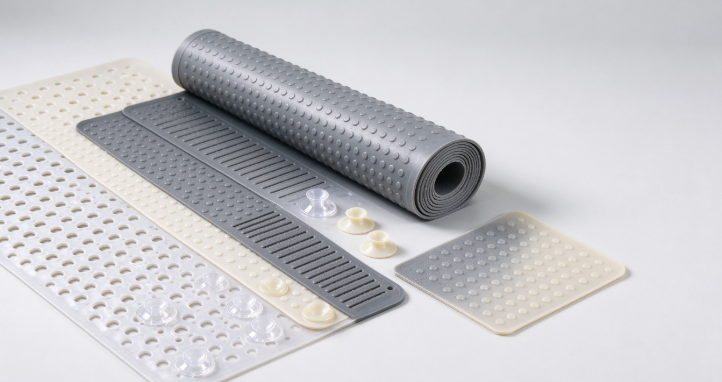
<h1><span style="color: rgb(31, 78, 121); font-size: 15pt;"><strong>Why the Category Is Changing</strong></span></h1><p style="text-align: justify;"><span style="font-size: 10pt;">The <strong>PVC Non-Slip Bath Mat with Suction Cups</strong> category is moving beyond a basic price-and-color purchase. International buyers increasingly evaluate the product as a combination of wet-area function, consumer communication, chemical compliance, packaging efficiency, visual merchandising, and supplier execution. A familiar household item now sits inside a much more disciplined sourcing process.</span></p><p style="text-align: justify;"><span style="font-size: 10pt;">The underlying need is easy to understand. The World Health Organization reports that falls are the second-leading cause of unintentional injury deaths worldwide, with about 684,000 fatal falls and 37.3 million falls requiring medical attention each year. These are global fall figures, not bath-mat performance statistics. Still, they reinforce the importance of safer environments and responsible communication around products intended for wet areas.</span></p><p style="text-align: justify;"><span style="font-size: 10pt;">Demand is also becoming more segmented. A discount retailer, hotel-supply distributor, children's homeware brand, pharmacy channel, and online marketplace seller may all buy suction-cup bath mats, but they do not share the same specification. The winners in this category will be programs that define the user, surface, material, documentation, and claims before production begins.</span></p><h1><span style="color: rgb(31, 78, 121); font-size: 15pt;"><strong>Five Global Sourcing Trends</strong></span></h1><p style="text-align: justify;"><span style="font-size: 10pt;">First, buyers are moving from generic “anti-slip” wording toward use-condition detail. They want to know whether suction cups require smooth non-textured surfaces, how the mat should be installed, how soap residue affects contact, and what cleaning instructions should appear on pack. This shift reduces ambiguity and encourages claims that can be supported by a defined test.</span></p><p style="text-align: justify;"><span style="font-size: 10pt;">Second, assortments are becoming more application-specific. Extra-long bathtub mats, square shower mats, massage textures, children's graphics, clear designs, solid colors, and easy-drain constructions solve different needs. A single universal SKU rarely serves every region and channel equally well.</span></p><p style="text-align: justify;"><span style="font-size: 10pt;">Third, private-label development is becoming more structured. Buyers increasingly arrive with artwork, packaging dimensions, label rules, compliance checklists, and inspection criteria. Suppliers must connect these brand requirements to an existing construction or clearly explain what requires new development.</span></p><p style="text-align: justify;"><span style="font-size: 10pt;">Fourth, product pages need evidence-rich content. Online shoppers cannot touch the surface or inspect the underside, so listings must show suction cups, texture, drain holes, dimensions, compatible surfaces, and cleaning steps. Better content is not decoration; it is part of expectation management.</span></p><p style="text-align: justify;"><span style="font-size: 10pt;">Fifth, sourcing teams are treating material declarations as order-specific documents. Flexible PVC can be an effective material direction, but “PVC” is not a complete chemical specification. Plasticizer requirements, restricted-substance lists, and testing obligations vary by market and by the way the product is marketed.</span></p><h1><span style="color: rgb(31, 78, 121); font-size: 15pt;"><strong>Safety Claims Need Better Evidence</strong></span></h1><p style="text-align: justify;"><span style="font-size: 10pt;">The phrase <strong>PVC Non-Slip Bath Mat with Suction Cups</strong> describes a functional design, but it should not be treated as a promise that slipping is impossible. Suction depends on multiple interacting variables: cup geometry, material flexibility, floor smoothness, surface contamination, water and soap, installation force, wear, and user movement. Packaging and online copy should explain the required surface and instruct users to check attachment before stepping onto the mat.</span></p><p style="text-align: justify;"><span style="font-size: 10pt;">For B2B buyers, a functional claim should point to a repeatable test method. The test brief should name the substrate, conditioning, cleaning process, water condition, installation method, load or pull direction, duration, number of samples, and acceptance criteria. If a buyer uses a laboratory method or market-specific standard, the exact version and scope should be stated in the purchase specification.</span></p><p style="text-align: justify;"><span style="font-size: 10pt;">Human factors matter too. Older adults, young children, and people with reduced balance may require a broader risk-control plan. A mat can complement environmental modifications, grab bars, supervision, and appropriate maintenance, but it cannot replace them. Responsible industry communication builds trust by defining both the product's function and its limits.</span></p><h1><span style="color: rgb(31, 78, 121); font-size: 15pt;"><strong>Material Compliance Is Market-Specific</strong></span></h1><p style="text-align: justify;"><span style="font-size: 10pt;">Regulatory planning begins with classification. Is the item an ordinary household bath mat, a product marketed specifically to children, or part of another regulated category? What claims appear on the packaging? Which country will receive it? The answers influence documentation and testing.</span></p><p style="text-align: justify;"><span style="font-size: 10pt;">In the United States, CPSC guidance explains that children's toys and child-care articles are subject to limits of 0.1% (1,000 ppm) for specified phthalates in accessible plasticized components. A bath mat does not automatically fall into either definition. However, child-focused graphics, naming, advertising, and intended use can affect the compliance discussion, so importers should obtain qualified advice for the actual product.</span></p><p style="text-align: justify;"><span style="font-size: 10pt;">For the European Union and other destinations, buyers commonly manage restricted-substance requirements through an applicable market checklist and supplier declarations backed by testing when required. The correct approach is not to paste every familiar acronym onto a purchase order. It is to identify the product, materials, components, claims, and destination, then map the rules that genuinely apply.</span></p><h1><span style="color: rgb(31, 78, 121); font-size: 15pt;"><strong>Design and Merchandising Directions</strong></span></h1><p style="text-align: justify;"><span style="font-size: 10pt;">The category now supports several distinct value propositions. Minimal solid-color mats fit modern bath ranges. Clear or translucent mats reduce visual weight. Pebble and brush textures emphasize tactile experience. Cartoon printing supports family-oriented merchandising. Longer formats address bathtub coverage, while compact square formats suit shower zones.</span></p><p style="text-align: justify;"><span style="font-size: 10pt;">Packaging is also part of product engineering. Hanging presentation, folded packs, belly bands, inserts, and e-commerce cartons affect shelf visibility, freight cube, deformation risk, and consumer understanding. A tightly folded mat may save space but needs validation for recovery and appearance after unpacking. Instructions must remain readable and accessible.</span></p><p style="text-align: justify;"><span style="font-size: 10pt;">The comparison below shows how common assortment directions change the buyer's priorities.</span></p><table style="min-width: 100px;"><colgroup><col style="min-width: 25px;"><col style="min-width: 25px;"><col style="min-width: 25px;"><col style="min-width: 25px;"></colgroup><tbody><tr><td colspan="1" rowspan="1"><p><span style="color: rgb(255, 255, 255); font-size: 9pt;"><strong>Assortment direction</strong></span></p></td><td colspan="1" rowspan="1"><p><span style="color: rgb(255, 255, 255); font-size: 9pt;"><strong>Primary buyer value</strong></span></p></td><td colspan="1" rowspan="1"><p><span style="color: rgb(255, 255, 255); font-size: 9pt;"><strong>Critical specification</strong></span></p></td><td colspan="1" rowspan="1"><p><span style="color: rgb(255, 255, 255); font-size: 9pt;"><strong>Common content need</strong></span></p></td></tr><tr><td colspan="1" rowspan="1"><p><span style="font-size: 8.5pt;">Classic solid-color PVC</span></p></td><td colspan="1" rowspan="1"><p><span style="font-size: 8.5pt;">Broad household appeal and easy range coordination</span></p></td><td colspan="1" rowspan="1"><p><span style="font-size: 8.5pt;">Color approval, dimensions, texture, suction layout</span></p></td><td colspan="1" rowspan="1"><p><span style="font-size: 8.5pt;">Top and underside photos; compatible-surface guidance</span></p></td></tr><tr><td colspan="1" rowspan="1"><p><span style="font-size: 8.5pt;">Printed family design</span></p></td><td colspan="1" rowspan="1"><p><span style="font-size: 8.5pt;">Visual differentiation and themed merchandising</span></p></td><td colspan="1" rowspan="1"><p><span style="font-size: 8.5pt;">Artwork registration, ink/print durability, claim classification</span></p></td><td colspan="1" rowspan="1"><p><span style="font-size: 8.5pt;">Accurate print preview, age-neutral or child-specific positioning</span></p></td></tr><tr><td colspan="1" rowspan="1"><p><span style="font-size: 8.5pt;">Extra-long bathtub mat</span></p></td><td colspan="1" rowspan="1"><p><span style="font-size: 8.5pt;">Greater longitudinal coverage</span></p></td><td colspan="1" rowspan="1"><p><span style="font-size: 8.5pt;">Flatness, dimensions, drain layout, pack recovery</span></p></td><td colspan="1" rowspan="1"><p><span style="font-size: 8.5pt;">Installed-size diagram and care instructions</span></p></td></tr><tr><td colspan="1" rowspan="1"><p><span style="font-size: 8.5pt;">Massage / brush texture</span></p></td><td colspan="1" rowspan="1"><p><span style="font-size: 8.5pt;">Tactile and exfoliating product story</span></p></td><td colspan="1" rowspan="1"><p><span style="font-size: 8.5pt;">Texture geometry and comfort expectation</span></p></td><td colspan="1" rowspan="1"><p><span style="font-size: 8.5pt;">Close-up texture image and plain-language use description</span></p></td></tr><tr><td colspan="1" rowspan="1"><p><span style="font-size: 8.5pt;">Hotel or project supply</span></p></td><td colspan="1" rowspan="1"><p><span style="font-size: 8.5pt;">Repeatability and replenishment</span></p></td><td colspan="1" rowspan="1"><p><span style="font-size: 8.5pt;">Approved sample, packing count, neutral color consistency</span></p></td><td colspan="1" rowspan="1"><p><span style="font-size: 8.5pt;">Specification sheet and carton identification</span></p></td></tr></tbody></table><p><span style="font-size: 10pt;"> </span></p><h1><span style="color: rgb(31, 78, 121); font-size: 15pt;"><strong>A Better Supplier Evaluation Model</strong></span></h1><p style="text-align: justify;"><span style="font-size: 10pt;">A capable supplier conversation starts with evidence. Does the catalog show the actual product family? Are material, size, surface design, suction backing, and applications documented? Can the supplier review a reference sample? Are appearance, dimensions, labels, packing, and buyer-defined inspection points included in the order process?</span></p><p style="text-align: justify;"><span style="font-size: 10pt;">Manufacturing visibility also matters, but factory photos should not be mistaken for numerical capacity claims. Buyers should request order-specific confirmation of tooling, sampling, production timing, inspection, packing, and shipment arrangements. If capacity, lead time, defect rate, or certification is important, it should be supported by current documentation rather than assumed from marketing.</span></p><p style="text-align: justify;"><span style="font-size: 10pt;">Zhejiang Jiajie Plastic Co., Ltd. presents a broad bath and household mat catalog for B2B sourcing, including PVC suction-cup bath mats, TPE/TPR options, massage designs, children's styles, sink mats, and door mats. Its published workflow asks buyers to confirm product type, material, dimensions, colors, pattern, packaging, target market, and inspection needs before order alignment.</span></p><h1><span style="color: rgb(31, 78, 121); font-size: 15pt;"><strong>What Buyers Should Do Next</strong></span></h1><p style="text-align: justify;"><span style="font-size: 10pt;">Build a category brief before requesting quotations. Divide requirements into three groups: mandatory compliance and function, preferred design and merchandising, and negotiable commercial details. This prevents a low unit price from hiding a mismatch in material, size, suction layout, packaging, or documentation.</span></p><p style="text-align: justify;"><span style="font-size: 10pt;">Then compare samples using the same protocol. Photograph the installation surface, use consistent cleaning and conditioning, measure dimensions and weight, inspect suction formation, review drainage and texture, and document packaging recovery. A <strong>PVC Non-Slip Bath Mat with Suction Cups</strong> should be evaluated as a complete system: product, surface, instructions, packaging, and intended user.</span></p><p style="text-align: justify;"><span style="font-size: 10pt;">The global direction is clear even without relying on speculative market-size forecasts. Buyers are asking for better-defined products, more disciplined claims, market-specific compliance planning, and more transparent order control. Suppliers that answer those needs can compete on execution and fit, not only on catalog breadth.</span></p><p style="text-align: justify;"><span style="font-size: 10pt;">Regional programs may emphasize different details. European buyers often build restricted-substance and packaging requirements into supplier manuals. U.S. buyers may separate ordinary household products from items specifically intended for children and evaluate claims accordingly. Hospitality programs may prioritize repeatability and neutral presentation, while online-first brands need strong visual explanation and packaging that survives parcel distribution. These are sourcing patterns, not substitutes for legal review in the destination market.</span></p><p style="text-align: justify;"><span style="font-size: 10pt;">Sustainability discussions are also becoming more precise. Buyers increasingly ask about material composition, product durability, packaging reduction, carton utilization, and end-of-life communication. A credible brief should avoid vague “eco-friendly” claims unless the claim has a defined basis. It is more useful to document the material, packaging change, test method, or measurable reduction that supports the statement.</span></p><h1><span style="color: rgb(31, 78, 121); font-size: 15pt;"><strong>Frequently Asked Questions</strong></span></h1><h2><span style="color: rgb(47, 117, 181); font-size: 12pt;"><strong>What is driving demand for suction-cup bath mats?</strong></span></h2><p style="text-align: justify;"><span style="font-size: 10pt;">Wet-area functionality, aging populations, family-safety awareness, bathroom renovation, hospitality replenishment, and broad household retail demand all support the category. Demand varies by channel and should not be reduced to one global forecast.</span></p><h2><span style="color: rgb(47, 117, 181); font-size: 12pt;"><strong>Is PVC still relevant for bath mats?</strong></span></h2><p style="text-align: justify;"><span style="font-size: 10pt;">Yes. Flexible PVC supports diverse colors, textures, prints, and suction-cup constructions. Buyers should define formulation and destination-market requirements instead of treating all PVC as identical.</span></p><h2><span style="color: rgb(47, 117, 181); font-size: 12pt;"><strong>Which trend matters most for importers?</strong></span></h2><p style="text-align: justify;"><span style="font-size: 10pt;">Specification clarity. Clear surface-compatibility instructions, documented claims, material requirements, and repeatable inspection methods reduce risk across product development and consumer use.</span></p><h2><span style="color: rgb(47, 117, 181); font-size: 12pt;"><strong>Are children's bath mats automatically covered by U.S. toy rules?</strong></span></h2><p style="text-align: justify;"><span style="font-size: 10pt;">Not automatically. Classification depends on intended use and regulatory definitions. Child-focused products should be reviewed with qualified compliance professionals using the final design, labeling, marketing, and destination.</span></p><h2><span style="color: rgb(47, 117, 181); font-size: 12pt;"><strong>How should buyers compare suppliers?</strong></span></h2><p style="text-align: justify;"><span style="font-size: 10pt;">Use the same product brief and sample protocol, then compare specification fit, evidence, customization feasibility, inspection control, communication, packaging, and commercial terms.</span></p><h1></h1><p></p>