
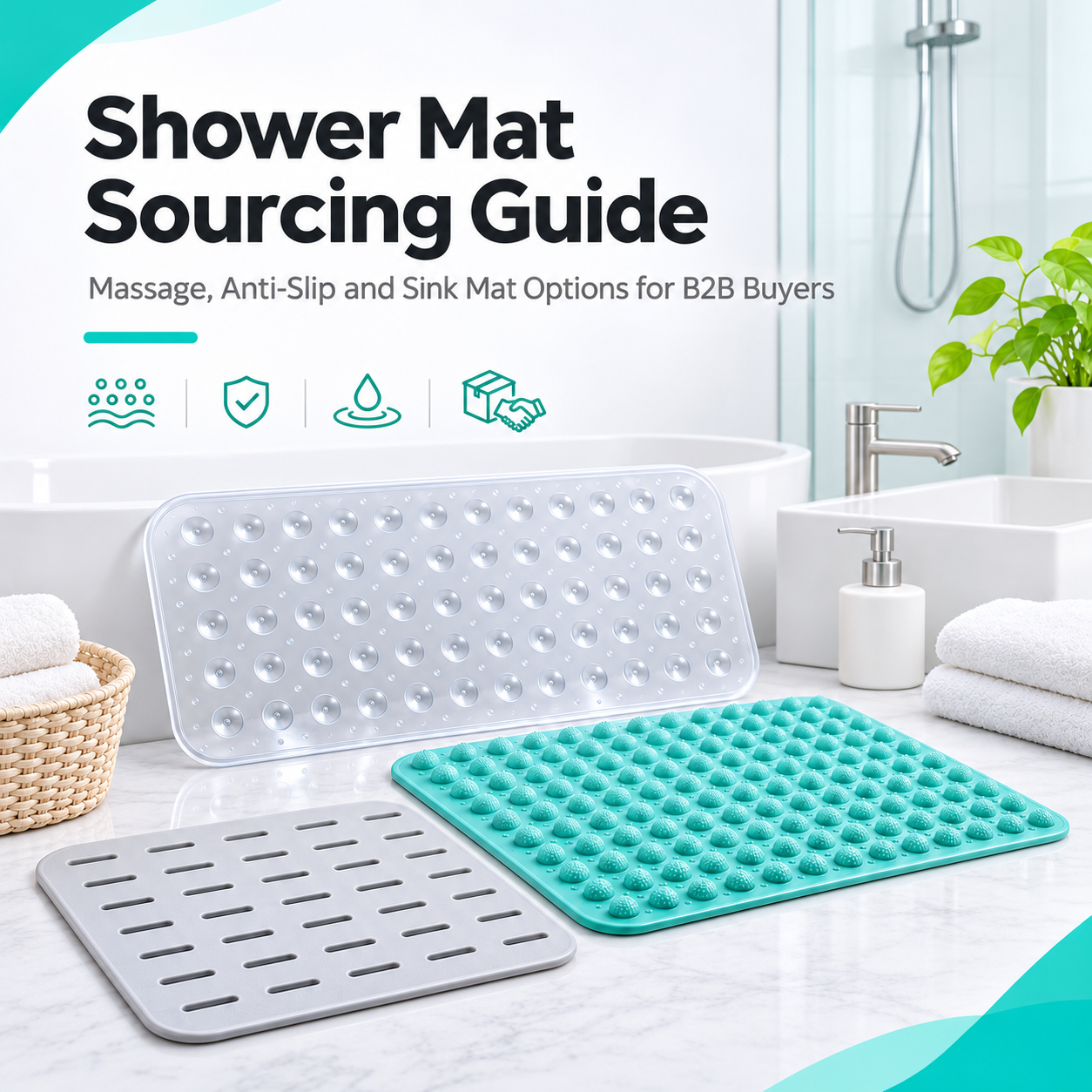
<h2>What a shower mat buyer actually needs to decide</h2><p>A shower mat is a small-ticket item that carries outsized risk. If it slips, traps water, or fails a retail compliance check, the cost lands on the importer or brand, not the factory. That is why sourcing a shower mat is less about picking a color and more about locking down four things: the material, the underside grip, the drainage and cleaning behavior, and the paperwork your market requires.</p><p>This guide is written for buyers building a shower mat range that may also include a <strong>massage bath mat</strong> and a <strong>sink mat</strong>. It walks through the operating conditions each mat faces, how material choice changes performance and compliance work, what to verify before placing an order, and the questions that separate a prepared <strong>bath mat supplier</strong> from one that only sends a price list.</p><h2>Match the mat to the wet area it will sit in</h2><p>Showers, bathtubs, bathroom floors, and sink surrounds are not interchangeable. Water depth, standing load, soap residue, and cleaning frequency differ, and so do the failure modes. Define the use case before comparing quotes.</p><h3>Shower floor mats</h3><p>These sit underfoot in a wet, soapy, frequently cleaned zone. Priorities are grip on a wet, smooth surface, fast drainage so water does not pool on top, and a surface that does not become slick once soap film builds up. A textured top helps, but the underside is what keeps the mat in place.</p><h3>Bathtub and massage bath mats</h3><p>A <strong>massage bath mat</strong> adds a raised, textured surface intended to stimulate the feet while standing. The trade-off is real: more texture means more contact points, which can improve the feel but also create more places for soap scum and mildew to collect. Buyers should ask how the texture is molded and whether the pattern can be cleaned with a brush. Textured massage surfaces are a documented feature of JIAJIELI's massage bath mat listings; confirm the exact pattern and cleaning guidance for the selected item during inquiry.</p><h3>Bathroom floor mats</h3><p>Placed outside the shower or tub, these face lower standing water but more foot traffic and more contact with dry skin, lint, and dust. Grip still matters on tile, and the mat should not curl at the edges where someone steps on it.</p><h3>Sink mats</h3><p>A <strong>sink mat</strong> is a different product class. It usually protects the basin or counter from scratches, cushions glassware, and manages small amounts of splashed water. Buyers should not assume a shower mat specification transfers to a sink mat; dimensions, thickness, and drainage openings are typically different. Confirm sink mat specifications separately with the supplier.</p><h2>TPE versus PVC: the material decision that drives everything else</h2><p>Two material families dominate flexible shower mats: TPE (thermoplastic elastomer) and PVC (polyvinyl chloride). Both can be molded with anti-slip undersides and textured tops. The choice affects feel, weight, odor, recyclability messaging, and the compliance route your market expects.</p><table style="min-width: 75px;"><colgroup><col style="min-width: 25px;"><col style="min-width: 25px;"><col style="min-width: 25px;"></colgroup><tbody><tr><th colspan="1" rowspan="1"><p>Consideration</p></th><th colspan="1" rowspan="1"><p>TPE</p></th><th colspan="1" rowspan="1"><p>PVC</p></th></tr><tr><td colspan="1" rowspan="1"><p>Typical buyer appeal</p></td><td colspan="1" rowspan="1"><p>Softer feel, positioned as eco-friendly in supplier listings</p></td><td colspan="1" rowspan="1"><p>Established category, broad supplier availability</p></td></tr><tr><td colspan="1" rowspan="1"><p>Compliance work</p></td><td colspan="1" rowspan="1"><p>Confirm material composition and any certifications per item</p></td><td colspan="1" rowspan="1"><p>Confirm plasticizer type and any certifications per item</p></td></tr><tr><td colspan="1" rowspan="1"><p>Odor and feel</p></td><td colspan="1" rowspan="1"><p>Often described as lower-odor; verify with a sample</p></td><td colspan="1" rowspan="1"><p>Varies by formulation; verify with a sample</p></td></tr><tr><td colspan="1" rowspan="1"><p>End-of-life messaging</p></td><td colspan="1" rowspan="1"><p>Recyclability claims require supplier documentation</p></td><td colspan="1" rowspan="1"><p>Recyclability claims require supplier documentation</p></td></tr></tbody></table><p>JIAJIELI's public catalog lists both TPE and PVC massage bath mats, including a TPE model (JJ-1601256319533) and PVC models (JJ-1601245717375 and JJ-1601232500736). One listing references TUV certification; certification scope, certificate number, and validity must be confirmed directly with the supplier before you rely on it in retail copy or tender documents.</p><p><strong>Decision rule:</strong> if your channel markets on material story and softness, sample TPE first. If your channel competes on price and established category familiarity, PVC remains viable, but verify plasticizer and compliance documentation rather than assuming it.</p><h2>How to verify anti-slip performance before you commit</h2><p>"Non-slip" is a marketing word, not a test result. Suppliers describe an anti-slip surface design, but the buyer needs evidence that the mat holds on the actual floor it will be used on. Shower trays, glazed tile, and textured stone behave differently.</p><ul><li><p><strong>Ask for the test method, not just the claim.</strong> Which standard, which surface, wet or dry, and what result? If the supplier cannot name the method, treat the claim as unverified.</p></li><li><p><strong>Test a sample on your target floor.</strong> Wet the surface with soapy water, place the mat, stand on it, and try to shift it with your foot. Repeat at the edges, where curling causes trips.</p></li><li><p><strong>Check the underside mechanism.</strong> Suction cups, textured backing, and full-contact grip surfaces behave differently. Suction cups need a smooth, non-porous surface to seal; textured tile may reduce hold.</p></li><li><p><strong>Check drainage.</strong> Water trapped under the mat keeps the interface wet and can accelerate slip risk and mildew. Confirm the mat's holes or channels drain freely.</p></li></ul><p>Record the results. A simple internal test log — floor type, wet condition, pass/fail, date — protects you if a retail partner or insurer asks how the product was validated.</p><h2>Certification and compliance: what to ask, and what to accept</h2><p>Compliance requirements vary by market and channel, and they change. Rather than assume a certificate covers your product, ask for the document and check that it names the model, the material, and the manufacturing site.</p><ul><li><p>Request the certificate for the specific model you are ordering, not a generic company certificate.</p></li><li><p>Check the issuing body, certificate number, scope, and expiry date.</p></li><li><p>Confirm whether the certificate covers the colorants and additives used in your order.</p></li><li><p>Ask whether the supplier can support your own market's testing requirements, and who pays for it.</p></li></ul><p>One JIAJIELI listing (JJ-1601232500736) references TUV certification and positions the mat for home and hotel shower rooms. Treat that as a starting point for verification, not proof. Hotel and contract buyers in particular should confirm documentation before specifying a product across a property.</p><h2>Supplier vetting: questions that reveal capability</h2><p>Most shower mat suppliers can quote a price. Fewer can answer consistently about tooling, batch consistency, and documentation. Use the same question set across every candidate so you can compare answers side by side.</p><h3>Product and tooling</h3><ul><li><p>Which models are existing tooling, and which require new molds? What is the tooling cost and who owns the mold?</p></li><li><p>Can you supply the same mat in multiple sizes and colors without a new mold?</p></li><li><p>What is the typical thickness tolerance, and how is it measured?</p></li></ul><h3>Quality and consistency</h3><ul><li><p>How do you check color consistency between batches?</p></li><li><p>What is your inspection process before shipment, and can we review the checklist?</p></li><li><p>Can you provide pre-production samples and keep a reference sample on file?</p></li></ul><h3>Documentation and logistics</h3><ul><li><p>Which certifications apply to this model, and can you send the certificates?</p></li><li><p>What packaging options do you offer for retail and bulk channels?</p></li><li><p>What are your production and shipping lead times for the quantity we are discussing?</p></li></ul><p>Lead times, tooling costs, and minimum order quantities are commercial terms that must come from the supplier in writing. Do not plan a launch date around an assumed figure.</p><h2>A staged sourcing process that reduces risk</h2><ol><li><p><strong>Define the brief.</strong> Use case, target market, material preference, size range, color range, packaging, and compliance needs.</p></li><li><p><strong>Shortlist three to five suppliers.</strong> Send the same brief and the same question set to each.</p></li><li><p><strong>Order samples.</strong> Test grip wet and dry on your target floor, check drainage, clean the mat the way an end user would, and inspect edges and finish.</p></li><li><p><strong>Verify documentation.</strong> Match certificates to the sampled model and confirm scope and validity.</p></li><li><p><strong>Run a pilot order.</strong> Inspect against a written checklist before scaling to full volume.</p></li><li><p><strong>Lock the specification.</strong> Keep a signed reference sample and a written spec sheet so future batches can be compared.</p></li></ol><h2>Common mistakes that cost buyers money</h2><ul><li><p><strong>Buying on price alone.</strong> A cheaper mat that fails a slip test or a compliance check costs more in returns and reputational damage.</p></li><li><p><strong>Accepting "non-slip" without a method.</strong> The claim is only as good as the test behind it.</p></li><li><p><strong>Ignoring the cleaning routine.</strong> Heavily textured massage mats need a cleaning plan; if the end user cannot clean it, reviews will reflect that.</p></li><li><p><strong>Assuming one certificate covers a range.</strong> Certificates are usually model- and material-specific.</p></li><li><p><strong>Skipping the reference sample.</strong> Without one, you have no baseline for the next batch.</p></li></ul><h2>Where JIAJIELI fits in a shower mat range</h2><p>JIAJIELI's public catalog covers bath, shower, massage, sink, door, and anti-slip mats for B2B sourcing and custom project discussion. The massage bath mat listings document anti-slip surface design and textured massage surfaces for showers, bathtubs, and bathroom floors, in both TPE and PVC. For buyers building a range, that gives a starting point across material families, but every specification — size, color, thickness, packaging, certification, and commercial terms — should be confirmed for the selected model during inquiry.</p>